
Introduction
Take a moment and look around you.
The book on your desk, the coffee cup with a printed logo, the shopping bag from your favorite store, the product packaging in your kitchen, the billboard on the highway, and even the business card in your wallet all have one thing in common—they exist because of printing.
Printing is so deeply woven into our daily lives that we rarely stop to think about where it all began.
Yet, there was a time when every single book had to be copied by hand. Monks and scribes spent months—or even years—carefully writing each page. Books were rare, expensive, and accessible only to royalty, religious institutions, and wealthy scholars. Knowledge spread slowly because reproducing information was an incredibly time-consuming process.
Everything changed with one revolutionary idea: reproducing text instead of rewriting it.
That idea gave birth to the printing industry, one of humanity’s most influential inventions. It transformed education, accelerated scientific discovery, fueled global trade, empowered businesses, and helped shape the modern world.
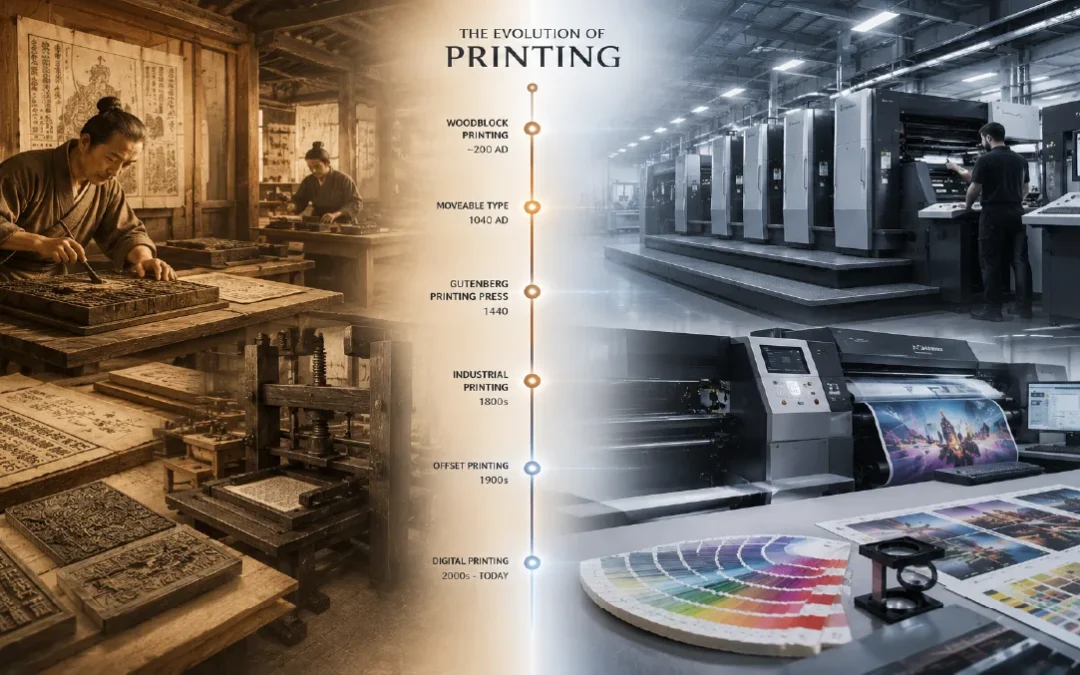
Today’s digital printers, offset presses, UV printing systems, and large-format machines are the result of centuries of innovation that began with simple carved wooden blocks in ancient China.
In this comprehensive guide, we’ll explore the complete history of printing—from its earliest origins to today’s advanced printing technologies—and discover how one invention changed civilization forever.
What Is Printing?
Printing is the process of reproducing text, images, graphics, or designs onto a physical surface such as paper, cardboard, fabric, plastic, metal, glass, or other printable materials. It enables the same content to be duplicated accurately and efficiently, making it possible to produce anything from a single custom print to millions of identical copies.
At its core, printing is a powerful method of communication. It allows ideas, knowledge, artwork, branding, and information to be shared consistently with people across different regions and generations.
Over the centuries, printing has evolved from manually carved wooden blocks to sophisticated digital technologies capable of producing high-quality prints in seconds. Today, it plays a crucial role in education, publishing, advertising, packaging, manufacturing, and visual communication.
Modern printing is used to produce a wide variety of products, including:
- Books and magazines
- Newspapers
- Business cards
- Brochures and flyers
- Product packaging
- Shopping bags
- Labels and stickers
- Banners and signage
- Office stationery
- Promotional products
- Custom apparel and textile prints
Whether you’re reading a book, opening a product package, or walking past a billboard, printing continues to shape the way businesses communicate and people access information every day.
Internal Link Opportunity (GreenwayPrint)
Looking for professional printing services? Explore our wide range of custom printing solutions, including business cards, packaging, banners, signage, promotional products, and more.
The Invention of Movable Type: A Major Step Forward
While woodblock printing was a remarkable innovation, it had one significant limitation—every new page required an entirely new wooden block to be carved by hand. This process was labor-intensive, time-consuming, and impractical for producing large numbers of different books.
Around 1040 AD, a Chinese inventor named Bi Sheng introduced a groundbreaking solution known as movable type.
Instead of carving an entire page onto a single wooden block, Bi Sheng created individual characters from baked clay. These reusable characters could be arranged to form words and sentences, printed onto paper, and then rearranged for the next page.
This innovation made printing far more flexible than traditional woodblock printing. Instead of carving hundreds of blocks for a single book, printers could reuse the same characters repeatedly, saving both time and effort.
Although movable type was an extraordinary invention, it was not widely adopted in China because the Chinese writing system contains thousands of unique characters. Organizing and managing such a large number of characters proved difficult, limiting its widespread use.
Nevertheless, Bi Sheng’s invention introduced the fundamental concept that would later revolutionize printing across Europe.

Johannes Gutenberg and the Printing Revolution
Nearly four hundred years after Bi Sheng’s invention, printing underwent its most transformative breakthrough in Europe.
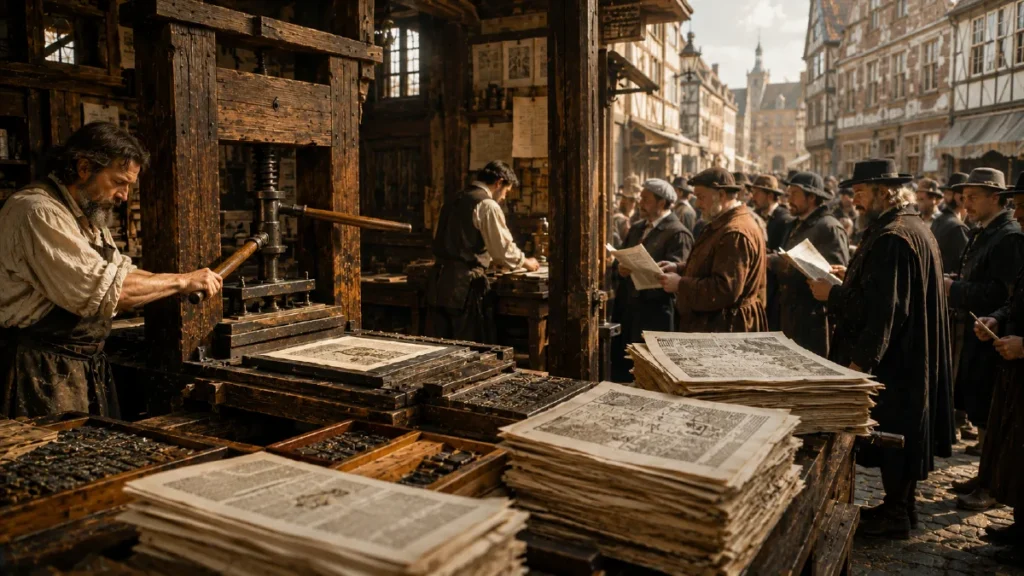
Around 1450, German goldsmith and inventor Johannes Gutenberg combined several existing technologies to create the world’s first practical mechanical movable-type printing press.
Unlike earlier methods, Gutenberg used durable metal type instead of wood or clay. Each letter could be cast in large quantities, arranged into pages, inked with oil-based ink, and pressed onto paper using a mechanical screw press adapted from wine-making equipment.
This combination dramatically increased printing speed, consistency, and efficiency.
For the first time in history, books could be produced in large quantities with remarkable accuracy. What once took months to copy by hand could now be printed in days.
Gutenberg’s invention marked the beginning of the Printing Revolution, changing not only how books were produced but also how knowledge spread throughout the world.

The Gutenberg Bible: A Masterpiece That Changed History
One of the earliest and most famous books produced using Gutenberg’s printing press was the Gutenberg Bible, printed around 1455.
Often referred to as the 42-line Bible, it is considered one of the finest examples of early European printing. Each page demonstrated exceptional craftsmanship, with crisp text, consistent typography, and impressive attention to detail.
The Gutenberg Bible proved that printed books could match the beauty and quality of handwritten manuscripts while being produced much faster and in greater numbers.
Its success encouraged printers across Europe to establish printing houses, leading to an explosion in book production over the following decades.
As books became more affordable and widely available, literacy increased, universities expanded, and ideas spread faster than ever before.
The Gutenberg Bible remains one of the most influential books in the history of printing and a symbol of the beginning of the modern information age.

How Printing Changed the World
Johannes Gutenberg’s invention did far more than improve the way books were produced—it transformed the course of human civilization.
Before the printing press, knowledge was limited to handwritten manuscripts that were expensive, rare, and accessible only to a privileged few. Ideas spread slowly, literacy remained low, and access to education was largely restricted.
The printing press changed all of that.
For the first time in history, books could be reproduced quickly, accurately, and in large quantities. As printed materials became more affordable, knowledge spread beyond monasteries and royal libraries into schools, universities, marketplaces, and ordinary homes.
Within a few decades, printing had become one of the most powerful tools for education, scientific discovery, cultural exchange, and economic growth. Historians widely regard it as one of the greatest inventions ever created because its influence reached nearly every aspect of society.
Let’s explore the remarkable ways printing reshaped the world.
Printing Made Knowledge Accessible to Everyone
Before the invention of the printing press, owning a book was considered a luxury.
Books were copied entirely by hand, often by skilled scribes who spent months—or even years—creating a single manuscript. As a result, books were extremely expensive and available only to wealthy families, religious institutions, and universities.
The printing press dramatically reduced both the cost and time required to produce books.
As more books became available, people from different social backgrounds gained access to education and information. Libraries expanded, schools grew, and reading gradually became a part of everyday life rather than a privilege reserved for the elite.
This rapid increase in the availability of printed materials played a major role in improving literacy across Europe and eventually around the world.
Knowledge was no longer confined to a few—it became something that millions could access.

Printing Accelerated the Scientific Revolution
The printing press became one of the most important tools for scientific progress.
Before printed books, researchers often worked in isolation. Scientific discoveries were difficult to copy and distribute, making collaboration slow and limited.
Printing changed this forever.
Scientists could now publish their observations, theories, and experiments in books that reached scholars across different countries. Instead of rediscovering existing knowledge, researchers could build upon the work of others, leading to faster innovation.
Many of history’s greatest scientific thinkers—including Nicolaus Copernicus, Galileo Galilei, and Isaac Newton—benefited from the widespread distribution of printed works.
Their ideas inspired generations of scientists and helped shape modern astronomy, physics, mathematics, and engineering.
Without the printing press, the Scientific Revolution would likely have progressed at a much slower pace.

Printing Revolutionized Religion and Public Thought
The printing press did more than spread books—it transformed the way people shared ideas.
For centuries, religious texts and philosophical writings were available only in limited numbers. Printing made it possible to produce these works in much larger quantities, allowing them to reach communities far beyond monasteries and academic institutions.
As books became more accessible, people gained greater opportunities to read, learn, and engage with different perspectives. New ideas circulated more widely, encouraging discussion, education, and intellectual curiosity across Europe.
Printing also helped standardize texts, reducing copying errors that were common in handwritten manuscripts and making written knowledge more consistent over time.
This exchange of ideas played an important role in shaping the cultural, educational, and intellectual development of societies around the world.
The Birth of Newspapers and Mass Communication
As printing technology improved, it became possible to produce information faster than ever before.
By the 17th century, printed newspapers began appearing across Europe, providing people with regular updates about politics, trade, science, and events happening beyond their local communities.
For the first time, information could reach thousands of readers within days instead of months.
Printing also gave rise to magazines, pamphlets, posters, advertisements, and public notices, creating the foundation of modern mass communication.
Businesses began using printed materials to promote products and services, while governments used printing to distribute official announcements and public information.
The printing press had evolved from a tool for publishing books into the world’s first large-scale communication network.
Printing Became the Foundation of Modern Business
As industries expanded, printing became essential to commerce.
Businesses needed catalogs, invoices, product labels, packaging, business cards, posters, and promotional materials to communicate with customers and build their brands.
Over time, printing evolved from producing books into supporting nearly every industry—from retail and manufacturing to healthcare, education, hospitality, and corporate marketing.
Today, whether it’s a luxury product box, a restaurant menu, a trade show banner, or custom-branded packaging, professional printing continues to play a vital role in how businesses present themselves to the world.
Modern commercial printing combines creativity, technology, and precision to help brands communicate effectively in both physical and digital marketplaces.
The Industrial Revolution and the Evolution of Modern Printing
The invention of Gutenberg’s printing press laid the foundation for mass communication, but the printing industry continued to evolve for centuries.
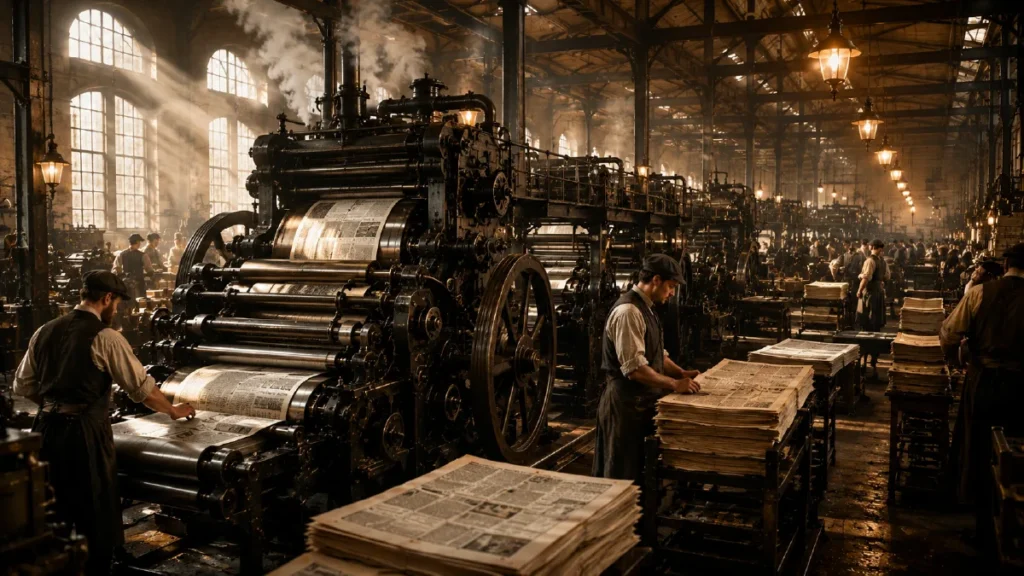
As the Industrial Revolution began in the late 18th century, rapid advances in engineering and manufacturing transformed printing from a manual craft into a large-scale industrial process.
Steam-powered machines, improved paper production, and mechanized printing presses dramatically increased speed, efficiency, and production capacity. What once took days to print could now be completed in just a few hours.
These innovations made printed materials more affordable than ever before, allowing newspapers, books, magazines, advertisements, and educational resources to reach millions of people around the world.
The Industrial Revolution marked the beginning of modern commercial printing.
The Rise of Offset Printing
By the early 20th century, another major breakthrough transformed the printing industry—Offset Printing.
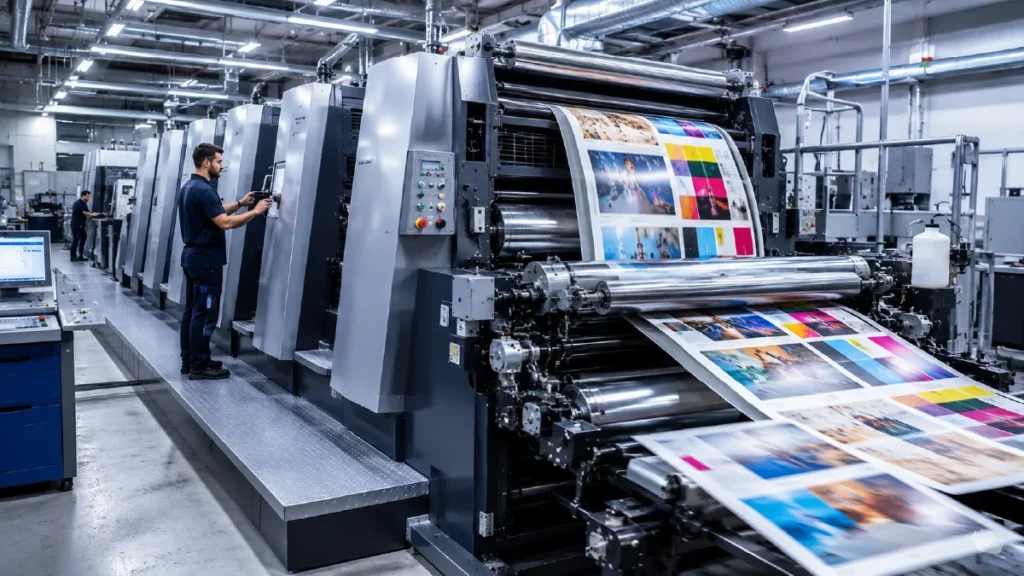
Unlike traditional letterpress printing, offset printing transfers ink from a metal printing plate to a rubber blanket before applying it to paper. This indirect printing method produces sharper images, consistent colors, and excellent print quality, especially for high-volume production.
Because of its speed, accuracy, and cost-effectiveness, offset printing quickly became the preferred choice for commercial printing companies around the world.
Today, offset printing is widely used for:
- Books
- Magazines
- Catalogs
- Brochures
- Packaging
- Corporate stationery
- Marketing materials
Even in the digital age, offset printing remains one of the most reliable solutions for large print runs.
The Digital Printing Revolution
The late 20th century introduced one of the most significant changes in printing history—Digital Printing.
Unlike offset printing, digital printing eliminates the need for printing plates. Files are sent directly from a computer to the printer, allowing businesses to produce high-quality prints quickly and efficiently.
Digital printing offers several advantages:
- Fast turnaround times
- Cost-effective short print runs
- Personalized printing
- Variable data printing
- On-demand production
- Minimal setup time
Because of its flexibility, digital printing has become the preferred choice for business cards, flyers, posters, brochures, labels, stickers, packaging prototypes, and customized promotional products.
For businesses that require speed and personalization, digital printing has become an indispensable solution.
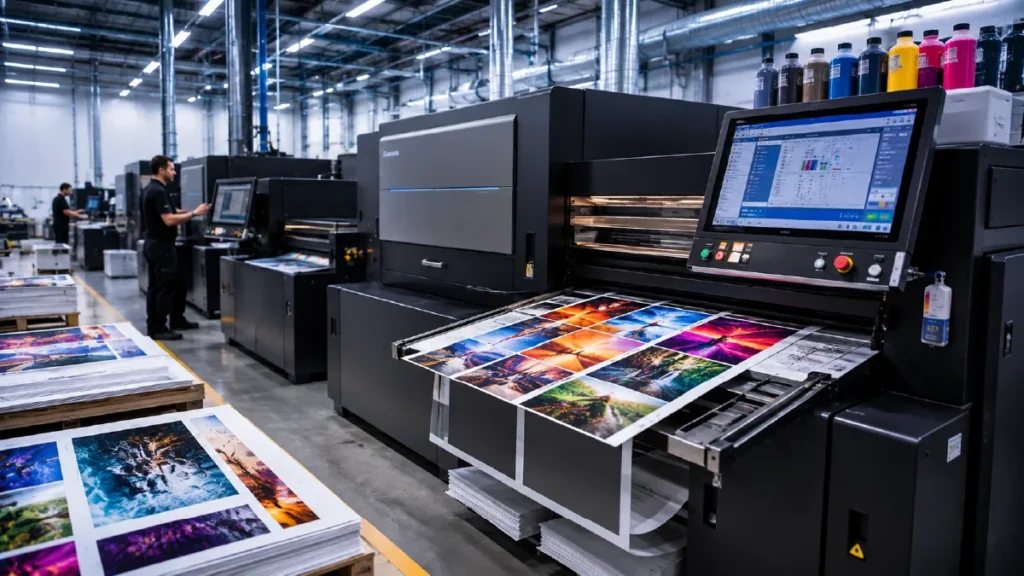
Modern digital production printer creating high-quality commercial prints.
Printing has expanded far beyond books and newspapers.
Today, businesses rely on specialized printing technologies designed for different materials, applications, and production volumes.
Some of the most widely used printing methods include:
- Offset Printing – Ideal for high-volume commercial printing.
- Digital Printing – Perfect for short runs and personalized products.
- Large Format Printing – Used for banners, posters, exhibition displays, and signage.
- UV Printing – Produces vibrant prints on acrylic, wood, glass, metal, and other rigid materials.
- Screen Printing – Commonly used for apparel, textiles, and promotional merchandise.
- Heat Transfer Printing – Ideal for custom clothing and sportswear.
- Flexographic Printing – Widely used in packaging, labels, and flexible materials.
Each technology serves a unique purpose, enabling businesses to choose the most efficient solution based on their project requirements.
The Future of Printing
Printing continues to evolve alongside advances in technology.
Artificial intelligence, automation, sustainable materials, and smart manufacturing are shaping the future of the printing industry.
Emerging trends include:
- AI-assisted print design
- Personalized packaging
- Sustainable and eco-friendly printing
- Smart labels with QR and NFC technology
- Automated production workflows
- On-demand manufacturing
- 3D printing innovations
As businesses seek faster, smarter, and more sustainable solutions, printing will remain an essential part of global communication, branding, and manufacturing.
Although the tools have changed dramatically over the centuries, the purpose of printing remains the same: to communicate ideas, preserve knowledge, and connect people through information.
Conclusion
The history of printing is a story of continuous innovation. From the first woodblock prints in ancient China to today’s advanced digital printing technologies, printing has transformed the way people learn, communicate, and do business.
Over the centuries, it has made knowledge more accessible, supported scientific progress, strengthened education, and helped businesses build powerful brands. Although printing technology continues to evolve, its purpose remains the same—to share ideas, preserve information, and connect people across generations.
As new technologies such as automation, artificial intelligence, and sustainable printing continue to shape the industry, printing will remain an essential part of our everyday lives.
Printing History Timeline
A Quick Journey Through the Evolution of Printing
| Year | Milestone |
|---|---|
| 2nd Century AD | Early printing techniques begin to emerge in Ancient China. |
| 868 AD | The Diamond Sutra becomes the world’s oldest surviving dated printed book. |
| 1040 AD | Bi Sheng invents movable type printing using ceramic characters. |
| 1450 AD | Johannes Gutenberg develops the mechanical movable-type printing press. |
| 1455 AD | The Gutenberg Bible is printed, marking a new era in publishing. |
| 1800s | Steam-powered printing presses revolutionize mass production during the Industrial Revolution. |
| 1904 | Offset printing is introduced, setting the standard for commercial printing. |
| Late 20th Century | Digital printing enables fast, on-demand, and personalized printing. |
| Today | AI, automation, and sustainable technologies continue to shape the future of the printing industry. |